1. Introduction
To download PDF: COVID 19 – A Guideline to Residential Buildings Elevator Safety During the Pandemic
In this guideline we will explain the technical aspects and considerations on the use of elevators in the time of the COVID-19 pandemic. Several options to allow for the social distancing in elevator are discussed, and what impact these measures will have on the building usage, lift passenger traffic and waiting times.
This guideline concentrates primarily on elevators in residential buildings, however, if you require information relating to the impact of the COVID-19 pandemic on commercial building elevator traffic, please refer to our website (www.elevatingstudio.com.au) to download our paper dealing with pandemic building population calculations and building population criteria.
Keeping a safe social distance during the COVID-19 Pandemic is one of the fundamental measures to prevent the spread of the severe acute respiratory syndrome Sars-CoV-2 virus. Depending on country, the recommended social distance is set between 1.5m and 2m.
However, keeping a social distance in an elevator is not easy. “Taking an elevator” is very common for most people, and most of us are accustomed to standing much closer to each other in an elevator than we would normally do in a larger space, or when being outdoors. Standing close to each other in an elevator is an ingrained habit.
In addition, due to our fixation on time management and obsession with “instant everything”, people are not very tolerant about waiting, indeed, waiting too long is often perceived as a violation of our right to manage and control our time1).
Lastly, the psychology of lockdown, and the psychology of the social distancing measures post-lockdown, suggests that sticking to the rules gets harder, the longer it continues, thus, if we want to ensure that the social distancing practices are applied in elevators in a sustainable manner, property owners ought to apply some special measures.
2. Elevators in residential buildings
2.1. Lift car (cabin) usage and fill-rate
Consider a commonly used elevator designed with a 1600 kg / 21-person lift car (or cabin), applying ISO 4190-12) dimension (2100 mm wide x 1600 mm deep). During the typical morning and evening peak elevator traffic situations, the car would usually be filled up to about 65% of the rated load, in other words, there would be 13-14 people inside the lift. This is a significantly higher versus the density required for safe social distancing.
Figure 1. Shows an example with a 26-person/2000 kg elevator car, with 16 persons inside the car (16/26 = 62% of the rated load). Even though the lift could technically carry more passengers, cultural norms in most countries means that lifts seldom fill up to more than about 60% of capacity.
In the illustration it is obvious that adequate social distancing is simply not possible!
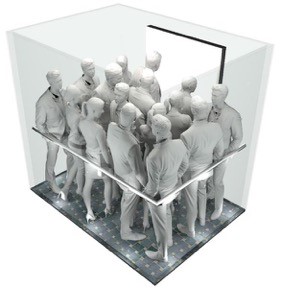
Figure 1. A 2000kg / 26-persen elevator car, filled with 16 persons (=62%)
Picture: Courtesy of the British Counsel of Offices
2.2. Complying with Social Distancing in an elevator car
To comply with social distancing, very low occupancy levels are required, for example, 4 to 5 persons in in a 21-person elevator. The shape of the lift car will impact how many people can safely be allowed in the car for social distancing.
It is recommended that stickers be applied to the elevator car floor, to indicate where passengers should stand and (preferably) in what direction they should face. Recent observation of lift passenger behavior has shown that in elevators where indication stickers have been applied, passengers are far more likely to comply with the recommended behavioral practices. See figures 2 and 3 below.
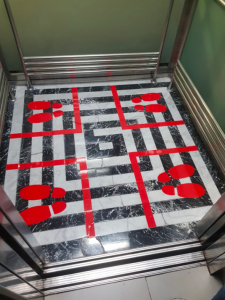
Figure 2. Clear warning signs and instructions how and where to stand in the elevator, and where not to stand – However, the 1-2 m distancing is not achieved. Picture: Courtesy of Jakarta Post |
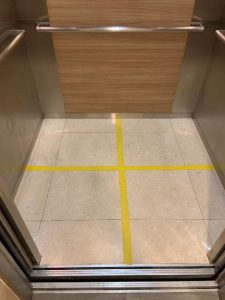
Figure 3. Car divided into 4 sections to allow for safe distancing, in a residential building. Picture: by Elevating Studio. There is no clear guidance how to stand. |
Regardless of the number of lifts in the property, the impact of reducing the number of passengers in a lift will significantly reduce the handling capacity of the buildings elevator system. Waiting times to travel downwards during morning peak will be substantially increased and queueing is likely to happen in the main lobbies when returning home in the evenings. Queuing in the lobby will also mean that the social distancing in the lobby will be exceeded.
As part of the lock-down measures imposed in many countries globally residential elevator traffic has been impacted while non-essential workers have been required to work from home. None the less, there are some basic technical control settings that could be adjusted on most lifts, that would greatly improve traffic handling, even with reduced cabin passenger limits. These recommendations are deal with later in this paper.
3. Technical measures to ensure social distancing – Elevators with Conventional Control
The following technical measures can be considered in elevators to ensure that the social distancing measures are enforced.
There are 2 main settings which are relevant in this respect:
- ‘Overload’ = A function to keep car doors open when the car is overloaded. A warning voice and or an alarm signal (buzzer) are activated. In some cases, a warning light or signal will flash on the elevator operating panel.
- ‘Bypass’ = A function where the elevator will automatically bypass Hall Calls, when the car is loaded to a pre-set limit. The elevator will not stop during the journey to pick up more passengers, when the bypass load is reached.
The measurement of the load inside the elevator car is done by a weighing sensor called Load Weighing Device (“LWD”). The LWD is required by code and is used in every elevator globally. The setting of the overload and bypass loads is typically done on site. The elevator contractor can be requested to adjust these controller settings, to the appropriate level(s).
The maximum population inside the elevator according to the social distancing rules, can be ensured by readjusting the ‘overload setting’ to 1 person higher than allowed by social distancing. In case social distancing allows maximum 5 persons, the overload is set for 450kg or 6 persons (6 x 75kg = 450kg). The by-pass function should be set to the load as per the social distancing rules, which is 375kg or 5 persons (5 x 75kg = 375kg).
The overload and bypass setting must be re-adjusted using test loads, which is (typically) a relatively easy adjustment to do. However, depending the type of LWD used, some elevators may require that the LWD is changed for another type, to cope with the clearly lower load functions. Please consult your elevator contractor for this.
The newly adjusted overload setting will cause the overload buzzer to activate, when the 6th person is entering the car (=exceeding the maximum allowed number of 5 passengers). The buzzer will indicate to the users, that the last person entering must leave, before the elevator will depart.
The newly adjusted bypass setting will prevent the car from stopping unnecessarily for landing calls when the maximum number of passengers allowed in the car for social distancing has already been reached.
In some countries or regions, the by-pass and overload setting should be adjusted in line with the local situation – for instance in some countries in Asia, Africa and South America, the use of a weight of 65kg or 68kg per person is more appropriate, in Australia, Europe, China and Russia 75kg is typically acceptable, and in US a weight of 85kg or 90kg may be more in line with the reality.
Note: Please be aware that when social distancing restrictions by the government are relaxed, and/or when a vaccine is found, the LWD settings must be readjusted back to the original values to ensure that the elevator system can handle the increased traffic expected after the removal of the restrictions.
4. Other methods used to minimize the spread of Sars-CoV-2 virus
There are several measures and methods to minimize the spread of bacteria and viruses, including the Sars-CoV-2 virus. The most common are:
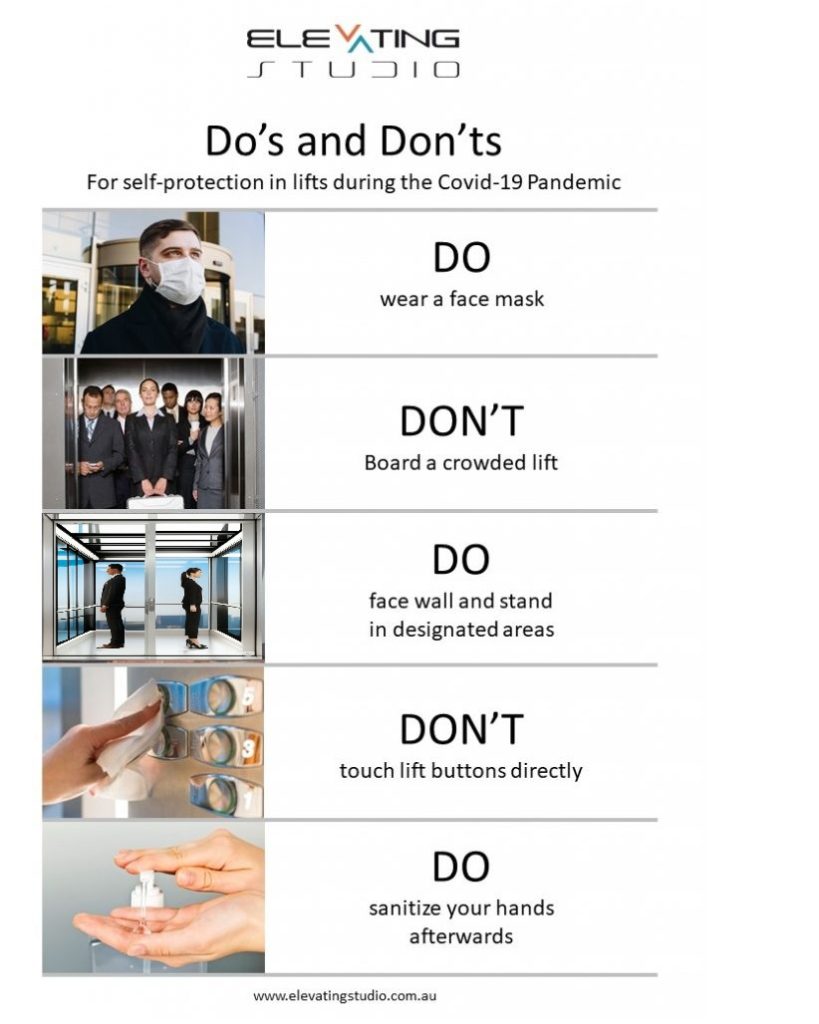
- Clear instructions how to behave or not to behave in elevators and escalators (see appendix)
- The use of face masks and gloves, and possibly glasses
- Use a blunt stylus or other object to operate elevator buttons (sharp objects such as a pen nib should not be used).
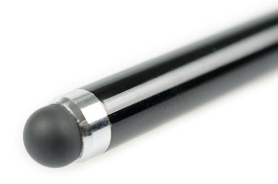
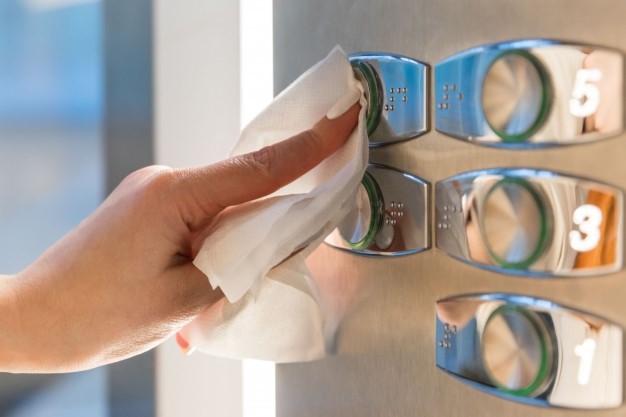
- Frequent cleaning of all touched surfaces with disinfectants (especially handrails, landing call buttons/panels, car operating panel and buttons, car door, mirrors, etc), with certain interval per day or per hour, or even per elevator ‘ride’.
Special technologies or applications found in the market:
- Air-filtering / Air-sterilizing ventilation units with or without HEPA filter (High-Efficiency Particulate Air). Those filter units can be installed inside elevator cabin or on top of the cabin. Some of these units even use UV light to sterilize the air.
- UV light in the cabin, to sterilize surfaces
- Apply special self-sterilizing or inherent antimicrobial materials (copper, etc.) for buttons, wall surfaces, handrails and elevator doors
- Apply special self-sterilizing or antimicrobial coating on the various surfaces (spray or lacquer)
- Special “no-touch” hologram buttons
Note:
The methods or special technologies should be considered in consultation with the elevator contractor. Some measures or cleaning materials may adversely affect the lifetime of some of the elevator components or parts (especially aggressive cleaning detergent or disinfectants, or paint or spray).
5. About Elevating Studio
This article was produced by Elevating Studio, one of the largest Vertical Transportation Consultants in Asia-Pacific, with offices in Australia, Singapore, Thailand, Malaysia and Finland. If you have any questions regarding this article or need further help, please contact us through:
6. References
- Wait for Free Practise
- https://www.smilesarasota.com/category/about-smile-sarasota/
- ISO4190, 2010 (E), Fourth edition 2010-05-15
- Elevator (Elevator) Installation – Part 1
- CIBSE Guide D: 2015
- The Chartered Institution of Building Services Engineers
- Page 4.5 Siikonen (Siikonen Profile)
- Behaviour Instruction https://www.hitachi.com/businesses/elevator/covid-19/?guideline
APPENDIX: BEHAVIOURAL INSTRUCTIONS4)